The Future of Clinical Psychological Science; Inaugural Conference of the Society for Clinical Psychology (APA Division 12), Atlanta, GA, February 1-3, 2024
Poster
Unveiling the Evolutionary and Ecological Underpinnings of People-Pleasing: An Exploratory Study Rajika Mehra, MA,
Abstract
The study will explore the evolutionary and ecological roots of people-pleasing behaviors. They may present as an individual's innate desire to appease, be liked by, and gain the validation of others, at the expense of personal values and needs. Svoboda (2008) labeled people-pleasers as "Doormats," highlighting the derogatory way the term is often used. Yet, when analyzed empirically, data may challenge the predominantly negative portrayal of people-pleasing in pop-psychology. A nuanced understanding may acknowledge both the adaptive and maladaptive aspects of said behaviors and conclude that people-pleasing is more than agreeableness, lack of assertiveness or the societal pressure to conform and/or comply.
PDF
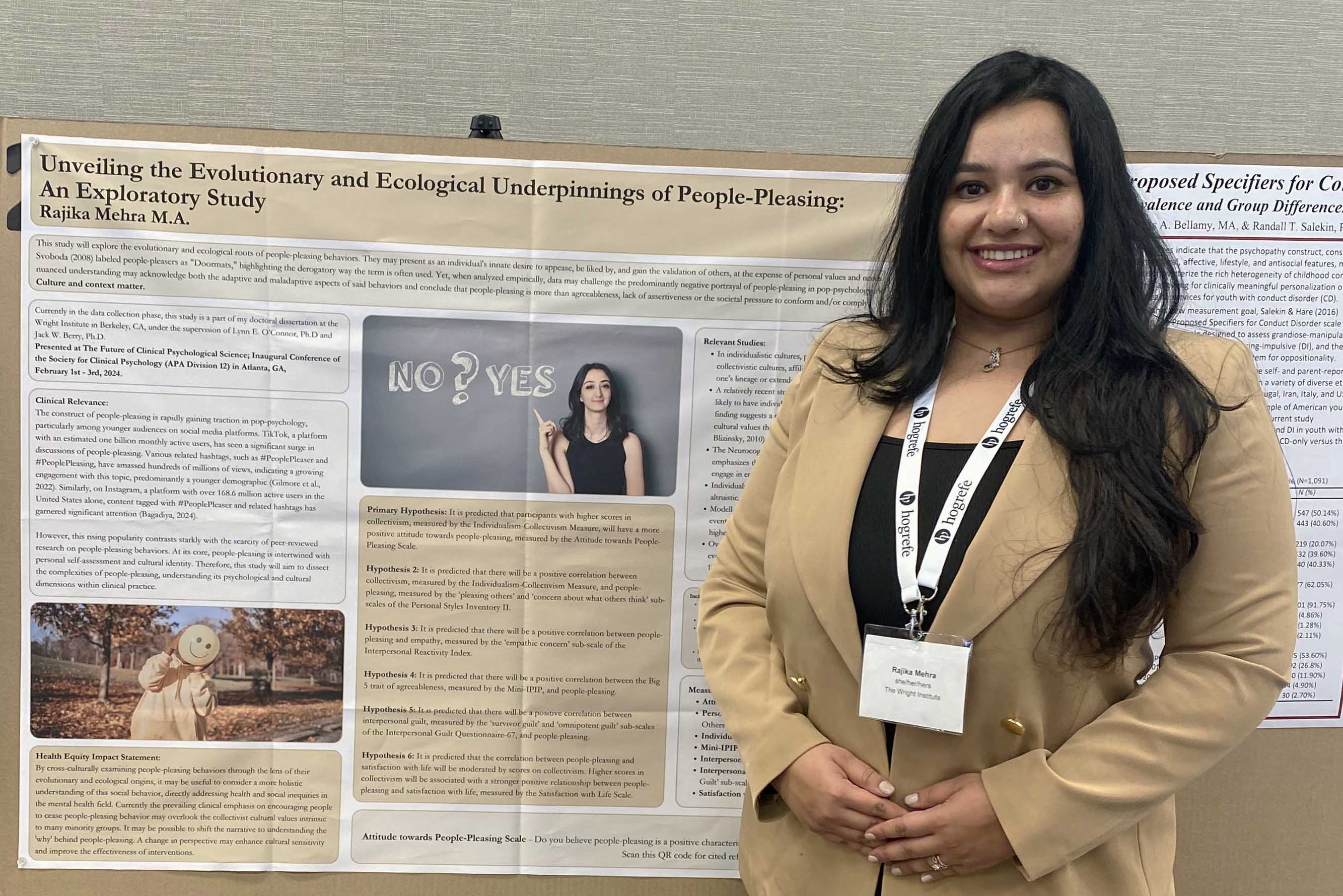 |
| Rajika Mehra, Exploring People Pleasing Behaviors |
Annual Convention of the Western Psychological Convention (Virtual) October 28 - 31, 2020
Poster
Living with Antisemitism Sari M. Kosdon, Lynn E. O’Connor, Jack W. Berry and David J. Stiver.
Abstract
In an anonymous online study of 242 Jewish-identified participants (71 men, 163 women, 8 other; mean age = 37.8 years) living in ethnically diverse communities we found levels of antisemitism significantly associated with depression, survivor guilt proneness, and self-hate. Involvement in the Jewish community was significantly associated with life satisfaction even when adjusting for the effects of discrimination. A subsample of 124 responded to open ended questions with narratives. Thirty percent indicated feeling endangered when identifying as Jewish.
PDF
Annual Convention of the Association for Psychological Science, Virtual Poster Showcase, June 1 - September 1, 2020
Poster
Living with Antisemitism Sari M. Kosdon, Lynn E. O’Connor, Jack W. Berry and David J. Stiver.
Abstract
In an anonymous online study of 242 Jewish-identified participants (71 men, 163 women, 8 other; mean age = 37.8 years) living in ethnically diverse communities we found levels of antisemitism significantly associated with depression, survivor guilt proneness, and self-hate. Involvement in the Jewish community was significantly associated with life satisfaction even when adjusting for the effects of discrimination. A subsample of 124 responded to open ended questions with narratives. Thirty percent indicated feeling endangered when identifying as Jewish.
PDF
Annual Western Psychological Association Convention, Pasadena, CA, April 26-29, 2019
Poster
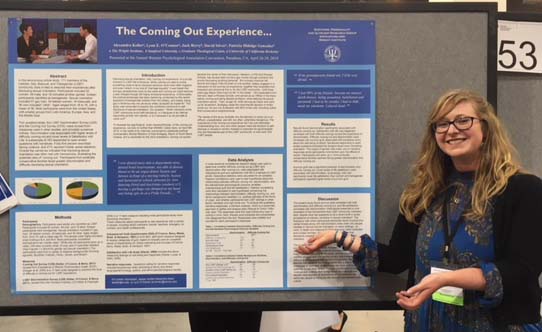 |
| Alex Keller |
The Coming Out Experience... Alexandra Keller, Lynn E. O’Connor, Jack Berry, David Stiver, and Patricia Hidalgo Gonzalez.
Abstract
In this anonymous online study, 171 members of the Lesbian, Gay, Bisexual, and Transgender (LGBT) community were invited to describe their experiences after disclosing sexual orientation. Participants included 93 women, 59 male, and 19 indicated another gender. Sixteen participants identified as transgender. Sexual orientation included 51 gay men, 34 lesbian women, 34 bisexuals, and 36 who indicated “other”. Ages ranged from 18 to 76, with a mean of 36. Most participants were from the United States, with smaller groups from Latin America, Europe, Asia, and the Middle East.
PDF
Annual Convention of the Association for Psychological Science, San Francisco, CA, May 24-27, 2018
Posters
Empathy-Based Guilt and Socioeconomic Status: An Empirical Investigation of Relationships Kevin W. Choi, Jack W. Berry, Lynn E. O’Connor, David J. Stiver, Suluck Chaturabul & Toni Li.
Abstract
Using an archival data set of 2541 adults, we examined the relationship between socioeconomic status (SES), empathy, empathy-based interpersonal guilt and depression. Consistent with our clinical impressions, we found that lower SES was associated with higher rates of survivor guilt, empathic concern for others, and depression.
PDF
 |
| Alex Keller and Lynn O'Connor |
Coming Out: The Experience of Discrimination Upon Disclosing Sexual Orientation to Family and Community Alexandra Keller, Lynn E. O’Connor, Jack Berry, David Stiver, Patricia Hidalgo Gonzalez & Sari Kosdon.
Abstract
In this anonymous online study 171 members of the Lesbian, Gay, Bisexual, and Transgender (LGBT) community were invited to describe their experiences when disclosing their sexual orientation. Participants included 93 women, 59 male, and 19 other. Sixteen participants were transgender. Sexual orientation included 51 gay men, 34 lesbian women, 34 bisexuals, and 36 other. Ages ranged from 18 to 76, with a mean 36. Most participants were from the United States, with smaller groups from Latin American, Europe, Asia, and the Middle East. Two questionnaires, the LGBT Discrimination Survey (LDS) and the Coming Out Survey (COS), were revised from measures used in other studies, and provided numerical indices. Discrimination was associated with higher levels of difficulty coming out and lower levels of Satisfaction with Life. A subsample of 163 responded to open-ended questions with narratives. Forty-five percent described facing violence, and 47% reported hostile verbal reactions. Overall the narratives indicated that disclosing sexual orientation was often met with homophobia, illustrating the potential risks of “coming out.” Participants from politically conservative families faced greater discrimination and difficulty disclosing sexual orientation.
PDF
Annual Convention of the Western Psychological Association, Sacramento, CA, April 27 - April 30, 2017
Posters
Caregiver Burden, Empathy-Based Guilt, and Depression Ashley Mezzasalma, Jack Barry & Lynn O'Connor.
Abstract
What is the impact of empathy-based guilt on the development of caregiver burden and depression? The study suggests that caregiver's perceptions of the caregiving role and the demands of the caretaker are greatly affected by his or her propensity to experience Survivor Guilt, and to a lesser degree, Omnipotent Guilt.
PDF
Survivor Guilt Predicts Depression and Anxiety in Iranian Immigrants Parisa Shoja, Jack W. Berry, David J. Stiver, Alexander Keller & Lynn E. O’Connor.
Abstract
The depression and high anxiety experienced by immigrants to the United States have usually been attributed to the loss of culture, and community in the country of origin. In fact, leaving behind economic, politial and social problems, immigrants are often better off after migration. Though living in improved conditions many find themselves burdened by survivor guilt as they worry intensely about the family and friends they left behind. Survivor guilt, known to be associated with psychological problems, may be the hidden cause of the depression and high anxiety in immigrant populations. In a study of 122 Iranian immigrants we contrasted survivor guilt with migratory grief/loss, finding survivoir guilt a better predictor of both depression and anxiety.
PDF
Annual Convention of the Western Psychological Association, Las Vegas, NV, April 30 – May 3, 2015
Posters
The Role of Guilt in Cross-Generational Conflicts in Asian American Families Toni Li, Yanlin Li, Jack W. Berry, David J. Stiver, Joseph Choy, Van Thuy Pham & Lynn E. O’Connor.
Abstract
In a preliminary exploration of the role of empathy-based guilt in conflicts between Asian immigrant parents and their adult children, we interviewed ten young adults. Themes emerged including: Parents inducing guilt in children, parents denigrating acculturation, parents micromanaging children’s activities, and the adult children’s frequent expressions of anger tied to fear of disappointing parents. Both parents and adult children appeared to worry about harming one another, and often expressed anger when overwhelmed with guilt. While underlying affection was obvious, the association between anger and guilt was explicit in only one interview. The often-heated conflicts between Asian immigrant parents and their adult children are familiar to clinicians working with multicultural families. The present study was designed to explore the role of anger as a defense against guilt in this apparent struggle between generations. This reinterpretation of conflict may be helpful to families engaged in frequent fighting. Reframing ongoing disputes as a reflection of guilt driven by underlying altruistic motivation may help to reduce what feels like an atmosphere of hostility and allow both parents and adult children to recognize their mutual affection and worry about one another.
PDF
Annual Convention of the Association for Psychological Science, San Francisco, CA May 22-25, 2014
Posters
Conflicts in Chinese American Families: The Role of Guilt and Anger, Toni Li, Jack W. Berry, Suluck Chaturabul, Yanlin Li, Lynn E. O'Connor, Kevin W. Choi, Shin Er Teh, Ila Srivastava, Zena Dadouch and Rella J. Kautiatinen
Abstract
We explored conflicts between Chinese immigrant parents and their Chinese American adult children. Eight young adults were interviewed. Themes emerged including: Parents inducing guilt in children, parents denigrating acculturation, parents micromanaging children's activities, and children worrying about disappointing parents. Worrying about one another was pervasive as was anger. The often heated conflicts between Chinese immigrant parents and their adult Chinese American children are familiar to clinicians working with multicultural families. However, little research has addressed this phenomenon. The present study was designed to begin an investigation of this apparent struggle between generations in ethnic Chinese families that may have implications for other immigrant families and may be helpful for mental health providers working with our increasingly diverse populations.
PDF
Empathy-based Guilt in Latino First-Generation College Students, Adrianna G. Hooper, Jack W. Berry, David J. Stiver, Lynn E. O'Connor, Suluck Chaturabul, Kevin W. Choi, Yanlin Li and Toni Li
Abstract
In an online anonymous survey, we compared 96 Latino first-generation undergraduate students to 105 Latino non-first-generation students on measures of empathy-based guilt (Survivor Guilt, Separation Guilt, and Omnipotent Responsibility Guilt), depression, and Satisfaction with Life. Latino first-generation students reported significantly higher levels of empathy-based guilt, depression, and lower levels of satisfaction with life compared to their non-first-generation student peers.
PDF
American Psychological Association, Annual Convention, Honolulu, Hawai'i, July 31-August 4, 2013
Poster
Compassion, Altruism, Contemplative Practices and Psychological Well-being , Rachna K. Rangan, Lynn E. O'Connor, Jack W. Berry, David J. Stiver, Kevin Choi, Yanlin Li, Toni Li, Winfred Ark and Rick Hanson
Abstract
The present study was designed to compare secular and religious contemplative practitioners to a normal (non-practicing) sample. Groups included: Tibetan and Theravada Buddhists, Christian meditators, Mindfulness (secular) and Yoga practitioners. We asked: Do practitioners of popular secular "mindfulness meditation" have the same kinds of positive outcomes as religious practitioners? Do different religions have different outcomes? Is contemplative practice embedded in a religion more likely to have a positive impact when compared to secular (non-religious) contemplative practice? The present study begins to shed light on these questions.
PDF
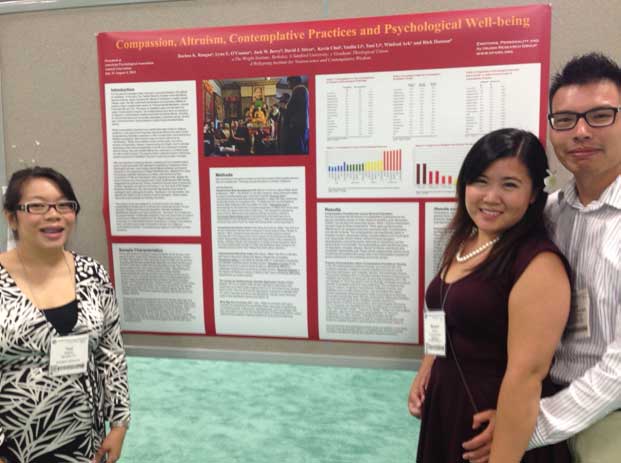 |
| From left, Toni Li, Yanlin Li, and Kevin Choi |
Association for Psychological Science, Annual Convention, Washington, DC, May 23-25, 2013
Poster
Guilt, Empathy, Altruism and Depression among Mainland Chinese, Asian- and European-Americans , Yanlin Li, Kevin W. Choi, David J. Stiver, Jack W. Berry, Rachna Rangan, Toni Li, Lynn E O'Connor
Abstract
In an online anonymous survey, we compared 46 Chinese from Mainland China to 82 Asian Americans and 258 European Americans on measures of empathy, empathy-based guilt, compassionate altruism, depression, and the Big Five personality factors. When compared to Asian Americans and European Americans, the Chinese scored significantly lower in Survivor Guilt, Empathic Concern and Perspective-Taking, Depression and Compassionate Altruism Towards Friends. Asian Americans were significantly higher in Depression than the other groups. Implications of the findings are discussed.
PDF
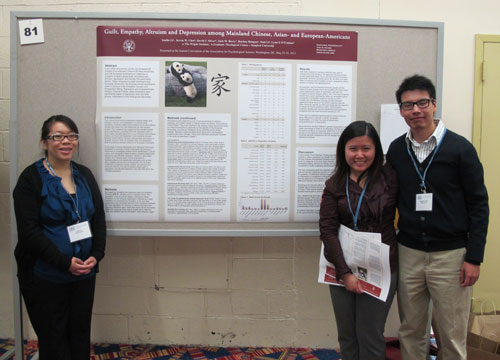 |
| From left, Toni Li, Yanlin Li, and Kevin Choi |
The Science of Compassion: Origins, Measures and Interventions, July 19-22, 2012 - Telluride, Colorado
Posters
Compassionate Altruism, Guilt, Depression and Contemplative Practices , Jack W. Berry, Lynn E. O'Connor, Rachna Rangan, David J. Stiver, Rick Hanson and Winfred Ark
Abstract
The present study was designed to compare various contemplative practices to one another, and to normal (non-practicing) sample. Groups included: Tibetan, Theravada, Zen, Christian, Mindfulness (secular), and Yoga. We are trying to determine if our previous findings were unique to Tibetan Buddhists or shared by other groups engaged in contemplative practice. Do practitioners of popular and basically secular "mindfulness meditation" demonstrate the same kind of emotion regulation, in terms of controlling or inhibiting empathy-based pathogenic guilt we had found in the Tibetan Buddhist sample? Is any particular system of beliefs important in terms of the kind of wellbeing commonly found in Tibetan Buddhists, that our prior study supported? Is contemplative practice embedded in a religion more likely to have a positive impact when compared to secular (non-religious) contemplative practice? The present study, while not providing complete answers, begins to shed light on these questions.
PDF
Development and Evaluation of the Compassionate Altruism Scale , Jack W. Berry, Lynn E. O'Connor, Rachna Rangan and David J. Stiver
Abstract
The centrality of altruism in human evolution is increasingly recognized. Most prior research on altruism has used the Self-Report Altruism Scale (Johnson et al., 1989). Across cultures, males have scored higher than females on the SRAS. We found that many items in the SRAS show differential item functioning indicating bias against female test-takers. The biased items reflect altruistic actions requiring substantial physical effort or courageous public displays. In attempting to measure altruism without gender bias, we adapted the Social Support Behaviors Scale (Vaux et al., 1989), which assesses social support received from family and friends. We reversed the roles in the scales, changing the wording to express the frequency with which the test-taker provides support to others. We added a subscale for altruism toward strangers. The present study provides the initial psychometric evaluation of this new instrument, the Compassionate Altruism Scale. .
PDF
Western Psychological Association, Annual Convention, April 28 - May 1, 2012, Burlingame
Poster
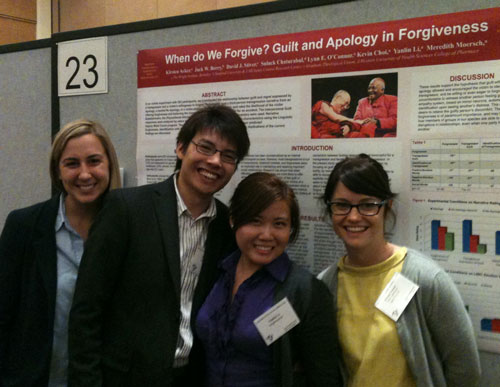 |
| From left, Meredith Moersch, Kevin Choi,Yanlin Li, and Kirsten Acker |
When do We Forgive? Guilt and Apology in Forgiveness, Kirsten Acker, Jack W. Berry, David J. Stiver, Suluck Chaturabul, Lynn E. O'Connor, Kevin Choi, Yanlin Li, and Meredith Moersch
Abstract
In an online experiment with 203 participants, we investigated the relationship between guilt and regret expressed by a transgressor and a victim's willingness to forgive. Participants read a third-person transgression narrative from an Apology, a neutral No Apology, or a victim-blaming No Apology condition, and rated the likelihood of the victim offering forgiveness and believing the transgressor felt guilt or responsibility for an accident. The Interpersonal Guilt Questionnaire, the Dispositional Altruism Scale, and the Big-Five Personality Inventory were used. Narrative responses were analyzed by raters for likelihood of forgiveness, and for linguistic characteristics using the Linguistic Inquiry Word Count program. The expression of guilt and apology by the transgressor predicted forgiveness, identification with the transgressor, and social and emotion word usage. Implications of the current findings are discussed.
PDF
Western Psychological Association, Annual Convention, April 28 - May 1, 2011, Los Angeles
Posters
Empathy, Guilt and Altruism: Tibetan Buddhist Meditation Practices, Lynn E. O'Connor, Jack W. Berry, David J. Stiver, Losang Monlam, Suluck Chaturabuland and Melissa Janson.
Abstract
In recent studies, Tibetan Buddhist monks with extensive meditation experience have been found to exhibit general psychological wellbeing and unusual skill at emotion regulation. These characteristics may influence their adaptation to political oppression in Tibet, and to the stressful experience of escaping from Tibet, followed by immigration to Nepal and/or India. Prior studies have demonstrated that refugees who have escaped countries where they were imprisoned and/or tortured were subsequently likely to exhibit high rates of Post Traumatic Stress Disorder and other serious mood and anxiety disorders. In contrast, several studies have indicated that Tibetan Buddhists, after long and dangerous flights across the Himalaya, have been arriving in India and Nepal with low levels of mental disorders, including PTSD. It has been suggested that this unusual and resilient response to traumatic conditions may be attributed to protective factors associated with the Tibetan Buddhist religion, for example the habitual tendency to see oneself as having suffered less than others, regardless of circumstances. In addition, beliefs that are an integral part of the religion itself, may play an important role. For example, Tibetan Buddhists believe in Karma, whereby prior actions ? including actions in past lives ? lead to events, something over which a person has no control in terms of the past. However, Karma is changeable, in accord with a person's current actions of "body, speech and mind." In this world-view, a better future may be predicted if a person is an active practitioner. The meditation practices commonly used have been empirically associated with psychological wellbeing in general.
PDF
PTSD in Returning Soldiers: Guilt and Witnessing Harm to Others, Joanna Morgan, Lynn E. O'Connor, Jack W. Berry, David J. Stiver, Vansen Wong, and Ngoc-Diem Nguyend.
Abstract
In an anonymous online study of 79 active members or veterans of the US Military (77.2% male; 81% Caucasian; 45.5% enlisted, 44.1% officers), we investigated the relationship between empathy-based guilt (survivor and omnipotent responsibility guilt), depression, satisfaction with life, and scores on a measure of Post-traumatic stress disorder (PTSD). We expected PTSD to be associated with empathy-based guilt, and that soldiers who witnessed harm happening to others would experience negative psychological outcomes at least to the same degree or more, than those who were harmed themselves.
PDF
Association for Psychological Science, Annual Convention, May 22-25, 2009, San Francisco
Posters
Green Guilt and Green Behavior Associated With Better Mental Health, Manisha Masher Sudindranath, Lynn E. O'Connor, Jack W. Berry, David J. Stiver, Suluck Chaturabuland and Reeta L. Banerjeee.
Abstract
In this anonymous online study of 220 participants, we found "green guilt" significantly associated with self-reported environmentally conscious behavior. "Green guilt" and "green behavior" were associated with good mental health, and negatively associated with depression, anxiety and neuroticism. In an experimental component of the study, two stories about workshops designed to raise consciousness about environmental issues were presented. In one condition, students were encouraged to think about their own behaviors, privately. In a second condition, students were forced to publicly "confess" their green or non-green behaviors. Participants, randomly assigned to one of the two conditions, were asked to write about the stories. When these narratives were compared on the Linguistic Inquiry and Word Count program (LIWC; Pennebaker), it was found that responses to the private condition contained significantly more positive emotion words.
PDF
Responses to Corporate Lay-Offs: Survivor Guilt in the Workplace, Lynn E. O'Connor, Jack W. Berry, David J. Stiver and Suluck Chaturabuld.
Abstract
In an online experimental study, participants responded to workplace scenarios in which the main character was promoted at work, while a secondary character was laid off. Participants were randomly assigned to one of four scenarios, which varied only by the relationship closeness of the characters: siblings, friends, acquaintances, or rivals. With increased relationship closeness, the main character was described as displaying significantly less positive affect and significantly more guilt, negative affect, and empathy, as well as more expressions of self-sacrifice and desires to help the laid off coworker.
PDF
Western Psychological Association, May 3-6, 2007, Vancouver, B.C.
Posters
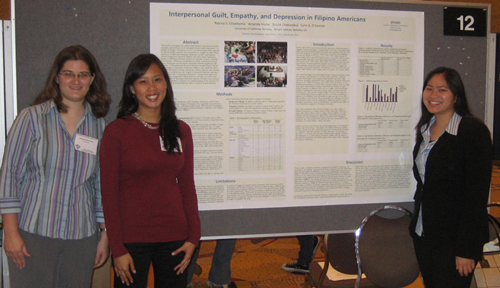 |
From left, Amanda Hume, Patrice S. Crisotomo, and Suluck
Chaturabul, University of California-Berkeley |
Interpersonal Guilt, Empathy, and Depression in Filipino Americans, Patrice Crisostomo, Amanda Hume, Suluck Chaturabul, and Lynn E. O'Connor.
Abstract
A sample of Filipino Americans (n=27), an ethnic group often ignored in mental health research, was compared to a sample of other Asian American (n=60) and European American (n=267) participants. Initial comparisons between Filipino and other Asian Americans found no difference between groups on subscales of guilt, empathy, and altruism. However, comparisons on these constructs between Asian Americans and European Americans showed significant differences. Guilt predicted altruistic behavior towards family, friends and strangers in European Americans while it only predicted altruism towards family in Asian Americans. Ethnic identity and cultural values may mediate the role of guilt in prosocial behavior, playing a more central role in European Americans. Interpersonal guilt may therefore be an especially salient factor in serving a prosocial function for those of European American descent. Further cross-cultural studies are needed to enhance our understanding of the function of guilt in both prosocial behavior and in common mental illnesses.
PDF
Life in the Office: The Downside to Winning in Social Comparison, Lynn E. O'Connor, Jack W. Berry, Patrice S. Crisostomo, Suluck Chaturabul, Amanda Hume, Stephanie Imp.
Abstract
In an experimental online study, 242 people responded to a story describing one highly skilled hard working manager being promoted during atime of layoffs in the wake of the high tech industry crash, while another skilled and hard working manager in another division was laid off. Participants were presented with one of four stories that varied only in the degree of closeness between the characters. Open-ended narrative responses of participants were coded and rated for a variety of emotional and behavioral reactions on the part of the main character. In addition responses were analyzed by the Linguistic Inquire Word Count computer-based method. Results indicated that across all closeness conditions, participants expected the main character to feel, think and do something that demonstrated empathy and survivor guilt towards the less fortunate character. There was, however, a significant linear trend in the levels of empathic responses across the closeness conditions.
PDF
Human Behavior and Evolution Society, June 2007, Williamsburg, VA.
Documentary
Film screening and discussion of documentary Kindness of Strangers, Lynn O'Connor, David S. Wilson, and Herb Gintis. P. Richerson (Chair), Kindness in film. Symposium.
For The Kindness of Strangers, a compelling documentary, produced in the wake of the Asian Tsunami, that provides a powerful and moving report into the science of compassion. Observational and character driven, the film uses strong personal journeys and leading scientists to provide a unique and ultimately encouraging insight into the mysteries of altruism and the true nature of mankind. Broadcast on ABC TV on 20 August 2006. 2007 winner Science Journalism, Australiam Museum.
Western Psychological Association, April 27-30, 2006, Palm Springs
Posters
Comparing vulnerability to distress among bisexual, homosexual and heterosexual women, Sara Liepe, Lauren Jenson, Jack Berry and Lynn E. O'Connor.
Abstract
This study compares 29 homosexual, 74 bisexual, and 546 heterosexual women using six measures of psychopathology. Demographicsgathered included ethnicity, religion, socioeconomic status, self-described current psychiatric disorders, and use of psychoactive medications.In addition, two clinicians summarized diagnostic information provided by participants, and estimated a primary and secondary diagnosis when appropriate. Results demonstrated no differences between homosexual and heterosexual women on any of the variables. Bisexual women, however, scored significantly higher than did heterosexual women on Low-Serotonin, Depression, Survivor Guilt, and Neuroticism. Bisexual women also scored significantly higher than homosexual women on Low-Serotonin, Depression, and Neuroticism. These results suggest that bisexual women are at higher risk for psychopathology.
PDF
Empathy-based guilt and responses to terrorism:memories two months later, Marisa Rainey, Amanda Hume, Jennifer Warner, and Lynn O'Connor.
Abstract
While the terrorist attacks on the World Trade Center and the Pentagon on September 11th changed the lives of most Americans, including those who neither lived near the event nor had friends or relatives directly impacted, some people appear to have suffered more extreme and protracted effects from the terrorist attacks than others. Using an instrument measuring Responses to Terrorism with subscales of Emotion, Cognition, and Behavior we found that participants who rated higher in negative emotions were significantly higher in proneness to survivor guilt, broadly defined. Using narratives written by the participants in response to open-ended questions, we found worry about others predicted fear and obsessional thinking.
PDF
The Impact of Diversity on Evolved Emotional Capacities: Empathy, Guilt, and Altruism Across Cultures, Patrice S. Crisotomo, Arleen S. Ramos and Lynn O'Connor.
Abstract
Our findings suggest that there are cultural and religious variations in the motivations for altruism. We found that Empathic Concern and Survivor Guilt significantly predict altruism towards strangers, across cultures, although the mean level of these empathy related variables may differ in different ethnic and religious groups. Furthermore, in this and prior studies, we have found that gender and age may have an effect on acts of altruism, across cultures, and the most motivating of emotions, survivor guilt, may serve as a mediator in the relationship between empathy, and acts of altruism.
PDF
Papers
Neurotransmitter Attributes Questionnaire and another perspective on psychopathology, Lynn O'Connor.
Abstract
In this study 901 participants completed an Internet-based survey, including the Neurotransmitter Attributes Questionnaire (NAQ), indicating serotonergic or dopaminergic dysfunction. Standard measures of mental disorders and self-reported diagnoses were used to validate the NAQ subscales. NAQ items were derived from questions prescribing professionals commonly ask new patients when determining the class of medication likely to be most helpful. The NAQ provides a method of screening patients whose symptoms call for psychopharmacological along with psychosocial treatments. Variations in mood and anxiety disordered patients call for a case-specific approach to pharmacological treatment; some patients are best helped by serotonergic agonists, others by dopaminergic agonists, and some by both. The NAQ was designed to aid decision-making early in treatment, leading to greater compliance and better outcome. Reliability and validity were established for each subscale. The NAQ may be used to standardize protocols in outcome research, and provide a new perspective on personality studies.