EPARG
 |
| Prof. Lynn O'Connor, Director |
 |
Prof. Jack Berry,
Co-Director and Statistician |
Our research group studies emotions, personality and empathy-based altruism, and their relationship to health and well-being, and to psychopathology.
Our work began with the observation that while people's problems are often a direct reflection of their socio-economic conditions, they are sometimes associated with an exaggerated or unrealistic concern about others and with high levels of interpersonal guilt.
We are particularly interested in the study and application of "prosocial psychotherapy."
Building on an evolutionary, feminist, and clinical theory (O'Connor, 1970; 2000; Weiss, 1986; 1993), we assume that altruism towards one's in-group is a fundamental human motivation in both clinical and non-clinical populations. Altruism is designed to hold the family and social group together and is a primary organizing principle in human life. However, when exaggerated or unrealistic, altruistic motivation may contribute to people's problems.
As we gathered data from many countries and cultures, we found ourselves puzzled over why we found guilt so often associated with psychopathology, particularly depression, and we began to see the need to study altruism directly, independent of guilt, as well as to continue our investigations of the regulation of guilt and other emotions. Our work has naturally branched into studies of personality, attachment, religion, forgiveness, and virtues (social norms).
While we are primarily interested in basic emotion and personality research from an evolutionary perspective, as scientist-practitioners, we are also interested in clinical and practical applications of emotion, personality and altruism research, such as the effects of clinical interventions including psychotherapy, counseling, and medications. Our clinical approach is based on positive relational theory. This theory is a highly integrative approach including contemporary biological, evolutionary and cognitive science, positive psychology, regulation-deregulation theory, feminist or what is now called "social-justice theory" and a relational theory of therapy (Lewis, Amini, & Lannon, 2000; O'Connor, 2000; Weiss, 1986; 1993). Our studies include clinical as well as non-clinical populations.
Concept Model
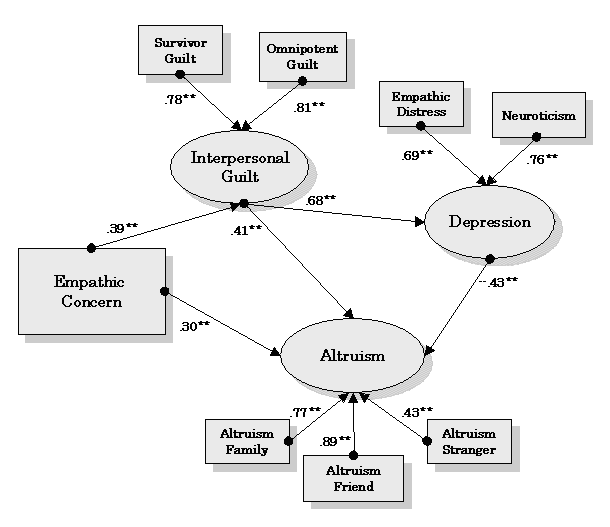
This structural model illustrates that guilt (based on worry about others) appears to have a significant and positive influence on engaging in altruistic behaviors except when it leads to Empathic Distress and Neuroticism. Neuroticism, a marker for BDNF and a high risk factor for depression, appears to inhibit altruistic actions. The Cumulative Fit Index=.96. All path coefficients were statistically significant at the .001 level. From O'Connor, L.E., Berry, J., Lewis, T., Mulherin, K., and Yi, E. (2007). "Empathy and Depression: The Moral System on Overdrive," Empathy and Mental Illness, T.F.D. Farrow and P.W.R. Woodruff (Eds.), Cambridge University Press.
Contact Us
The Wright Institute
2728 Durant Avenue
Berkeley, CA 94704
Attn: Professor Lynn O'Connor
(510) 841-9230
e-mail: lynnoc AT lynnoc.com